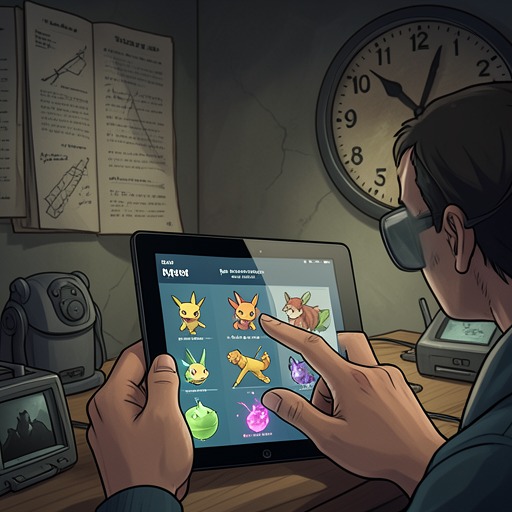
Pokédex
Pokemon Go: The Ultimate Beginner's Guide For Kindle Book Tips And Trick How to Become The Best Pokemon Trainer: This Kindle Book Will Answer Your Unsolved QuestionsThe Pokédex is the collection register at the center of Pokémon GO’s completionist structure. Located in the game’s central menu, it records the Pokémon caught by the player and gives the act of finding creatures a durable, visible result: each encounter becomes part of an expanding catalog rather than an isolated capture.
Definition and Location
The Pokédex appears among the five principal options in the central menu, alongside Tips, Shop, Pokémon, and Items. Its position makes it one of the game’s basic organizing tools. While the other menu options explain mechanics, sell or manage resources, or display the player’s current creatures, the Pokédex gathers the longer history of the player’s progress into a single record.
The register is therefore both practical and symbolic. It shows what the player has already encountered or caught, while directing attention toward what remains absent. The game’s interface turns collection into a readable sequence of completion and incompletion: every new Pokémon enlarges the player’s recorded knowledge, but the open spaces of the catalog preserve the challenge of continuing.
Connection to Pokémon History
The Pokédex carries forward one of the franchise’s oldest player objectives. In the broader Pokémon game tradition, human Pokémon Trainers catch and train fictional creatures, with one general goal being to complete the Pokédex by collecting all available Pokémon species in the region represented by a particular game. The same collecting impulse exists alongside the training of a powerful team and competition against other Trainers, so the catalog is not separate from the franchise’s culture of battling; it is one of its foundational expressions.
This objective belongs to a much larger cross-media history. Pokémon began as a pair of Game Boy video games developed by Game Freak and published by Nintendo, then expanded into trading card games, animated television shows and movies, comic books, and toys. The Pokédex in Pokémon GO thus functions as a mobile continuation of a familiar franchise promise: knowledge and achievement are accumulated by encountering, identifying, and collecting distinct species.
Operation in Pokémon GO
In Pokémon GO, the catalog is populated through activity in the physical world. Nintendo and Niantic Labs combine GPS, augmented reality, and mobile graphics to place Pokémon encounters in the player’s surroundings. The player’s avatar follows real movement, and the game requires an internet connection and location services to translate walking through the real world into movement within the game. Captures made during that exploration are then reflected in the Pokédex.
The register’s purpose is consequently tied to the game’s spatial design. Players encounter Pokémon while moving through streets and neighborhoods, and they may visit real monuments represented as PokéStops to obtain items. The game presents this process as more than a sequence of menu actions: exploration with friends, visits to landmarks, and connections with nearby would-be Pokémon Trainers all become part of the path toward a fuller catalog.
The Pokédex also sits within a resource system that makes continued collecting possible. The central menu provides access to Pokémon and Items, while the Shop offers tools such as Incense, which attracts Pokémon around the player for thirty minutes, Lure Module, which attracts Pokémon around a PokéStop for thirty minutes and can benefit other players, Poké Balls, Egg Incubator, Pokémon Storage Upgrade, and Bag Upgrade. These items do not replace the catalog’s basic function, but they support the encounters and storage capacity through which the catalog grows.
Scale and Progression
The guide describes the Pokédex as containing more than 700 Pokémon in total and urges players to keep catching them in order to become stronger. That scale transforms the register from a simple checklist into a long-term progression system. A player can gain experience for catching Pokémon, including additional experience for a new Pokémon, so an unfamiliar species contributes not only to the catalog but also to advancement through the game’s levels.
Collection extends beyond immediate encounters. Pokémon eggs are placed in incubators and hatched by walking in real life while the game remains open. The guide identifies 2-kilometer, 5-kilometer, and 10-kilometer eggs, with the 10-kilometer egg described as the rarest of the three. Hatching provides experience and Stardust, and the longer the required distance, the greater the rewards and the better the Pokémon that may emerge. The Pokédex therefore records the outcome of both direct capture and a slower, distance-based form of discovery.
Competitive and Social Significance
The catalog’s completionist pressure is connected to Pokémon GO’s competitive and social ambitions. Medals reward achievements such as catching a certain number of Pokémon of one type or walking a specified distance, although the guide says that these medals offer little beyond bragging rights. The Pokédex similarly gives collection a public-facing dimension: it provides evidence of persistence and knowledge even when the immediate reward is not a material advantage.
At level five, players can join one of three teams and compete at Pokémon GO Gyms, either running their own Gym or fighting on behalf of a team at other players’ Gyms around the world. The Pokédex does not itself determine the result of those contests, but it represents the accumulated roster and expertise that underlie the player’s claim to Pokémon mastery. In this way, the catalog links solitary discovery to a broader identity as a Trainer within a competitive community.
The guide also places the Pokédex within an expanding device ecosystem. The Pokémon GO Plus is presented as a possible future addition costing $34.99, allowing players to visit PokéStops and catch Pokémon without looking at their phones. A wearable interface would shift some collecting activity away from the main screen while preserving the same underlying objective: encounters still become entries in the Pokédex, even when the act of capture is mediated by another device.